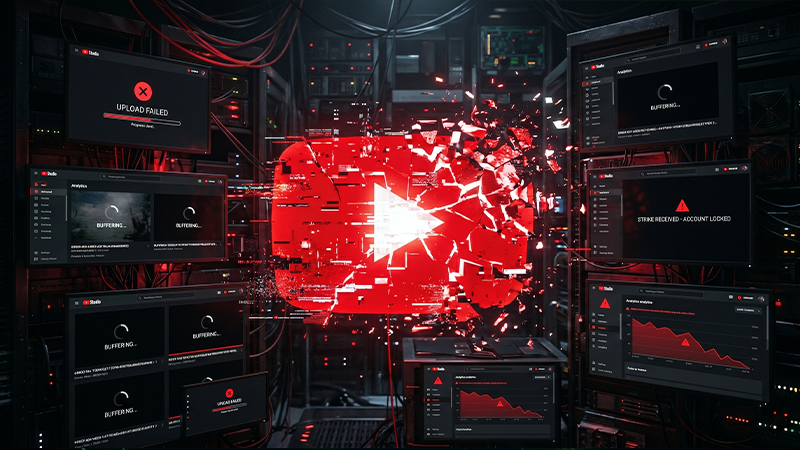
YouTube is having a bad week — and if you’ve been staring at a spinning upload bar or hitting a dead-end error screen today, you’re not alone. On May 13, 2026, a significant YouTube outage began affecting content creators and businesses worldwide, with users reporting that video uploads are completely broken. The platform is throwing a frustratingly unhelpful message — “Oops, something went wrong” — and leaving creators with no estimated fix time and no clear workaround.
Here’s everything we know right now, what this means for your content strategy, and what you can do while YouTube sorts itself out.
What’s Happening With YouTube Right Now?
The YouTube video upload outage was first flagged widely on Downdetector, the platform monitoring service, which recorded a sharp spike in user complaints starting around 3:00 PM today. Reports are coming in from users across multiple countries, confirming this is not a regional issue — it’s global.
The key facts as of now:
- Video uploads are failing — creators attempting to publish new content are met with error screens
- YouTube Studio is affected — the dashboard creators rely on to manage, schedule, and publish content is experiencing issues
- Video watching appears unaffected — regular viewers can still stream content normally
- The error message being reported is “Oops, something went wrong” — YouTube’s standard response to a server-side failure it hasn’t publicly addressed yet
- YouTube has not issued an official statement at the time of publishing
For individual creators this is an inconvenience. For businesses that depend on YouTube as part of their marketing calendar — scheduled product launches, campaign videos, tutorial content — this is a workflow disruption.
This Is the Second Google-Owned Platform to Go Down This Week
Here’s what makes this outage particularly notable: it comes exactly one day after a major Google outage on May 12, 2026.
Yesterday, Google’s core services — including Search — went down for users worldwide, with Downdetector logging over 3,300 complaints at peak. Users reported blank pages, failed searches, and complete loading failures across Google’s ecosystem. The issue resolved within hours, but left a lot of questions about backend stability across Google’s infrastructure.
Two consecutive days of outages across Google properties is not normal — and it’s raising eyebrows in the tech community. Whether these incidents share a root cause or are independent failures, the pattern suggests something deeper is being worked through in Google’s server infrastructure.
For now, YouTube’s upload systems are the casualty.
Why YouTube Upload Outages Hit Creators Harder Than They Should
Most platform outages are temporary. But for creators and businesses, the damage isn’t just in the downtime — it’s in the cascade effect that follows.
Algorithm timing matters. YouTube’s recommendation engine rewards videos that perform well in the first 24–48 hours after upload. If a scheduled video can’t go live on time, that window shifts, affecting organic reach, subscriber notifications, and ad revenue for monetized channels.
Content calendars break. For marketing teams and agencies managing YouTube as part of a broader social strategy, a single broken upload throws off scheduling across multiple platforms — especially if the YouTube video is the anchor piece that feeds shorter clips to Instagram Reels, TikTok, and LinkedIn.
Client commitments get missed. For agencies and freelancers who manage YouTube channels on behalf of clients, platform outages create awkward conversations. “YouTube is down” is true — but it doesn’t always land well when a deadline was promised.
This is exactly why businesses that rely heavily on a single platform for content distribution are exposed. Platform dependency is a real risk that doesn’t get talked about enough in digital marketing strategy conversations.
What Can You Do Right Now?
While YouTube works through the outage, here’s how to handle it without losing your mind:
1. Don’t keep retrying the upload. Repeated failed uploads can create duplicate processing queues in YouTube Studio that cause headaches when the platform recovers. Upload once, wait for a status.
2. Check YouTube’s official status page. Go to Google Workspace Status Dashboard — it’s the most reliable first-party signal for when services are being restored.
3. Monitor Downdetector. The complaints graph on Downdetector gives you a live read on whether the issue is growing, plateauing, or resolving. A declining complaint volume usually means the fix is rolling out.
4. Prepare your content offline. Use the waiting time to finalise your thumbnail, description, tags, and end screens. When the platform comes back, you can publish instantly.
5. Communicate proactively if you manage client channels. A quick message to clients explaining the outage — with a screenshot of Downdetector if needed — is far better than silence followed by a missed deadline explanation.
6. Use the downtime for cross-platform repurposing. If the video was ready, export shorter cuts for Instagram Reels, TikTok, and LinkedIn while you wait. The YouTube upload can go live as soon as the outage resolves.
What This Outage Reveals About Platform Dependency
The honest takeaway from today’s outage isn’t really about YouTube — it’s about what happens to your brand’s content distribution when a single platform decides to have a bad Tuesday.
Businesses that run their entire video strategy through YouTube, their entire social presence through Instagram, or their entire customer communication through WhatsApp are one server failure away from going dark. That’s not a theoretical risk — today is proof.
A resilient digital strategy doesn’t just ask “what platform should we post on?” It asks “what happens to our content pipeline if that platform goes down for six hours?” The answer should never be “everything stops.”
Cross-platform publishing, content stored in owned channels (your website, email list, YouTube alternatives), and a social media strategy that doesn’t live and die on one algorithm — these are not nice-to-haves. They’re the difference between a minor inconvenience and a genuine business disruption.
The Bigger Picture for Content Creators and Brands
YouTube has over 2.5 billion monthly active users — making it the world’s second-largest search engine and the dominant platform for long-form video content. When it goes down, the impact isn’t just felt by individual creators. It hits:
- E-commerce brands running product video campaigns
- Educational platforms publishing course content
- Marketing agencies managing client channels on deadlines
- Small businesses in markets like the UAE and Lebanon where YouTube is a primary discovery channel for services
- Individual creators whose revenue depends on consistent publishing schedules and algorithmic momentum
Today’s outage is a reminder that for all its scale and reliability, YouTube — like every platform — is infrastructure you don’t own or control. Your audience is on YouTube, but your strategy should never be entirely dependent on YouTube.
Frequently Asked Questions
Why can’t I upload videos to YouTube today? YouTube is experiencing a platform-wide outage as of May 13, 2026, affecting video upload functionality globally. The error message “Oops, something went wrong” is being reported by users worldwide. Video watching appears to be unaffected. Monitor Downdetector or YouTube’s official X account for restoration updates.
Why does YouTube keep saying “Oops, something went wrong”? This error message is YouTube’s catch-all response to a server-side failure — it typically appears when the platform’s backend cannot process a request, which happens during outages, high-traffic events, or internal infrastructure issues. It is not caused by your browser, internet connection, or account. During an active outage, no troubleshooting on your end will resolve it.
How long do YouTube outages usually last? Based on historical data, YouTube outages typically resolve within 1 to 4 hours. The February 2026 outage — which was significantly more severe, affecting over 300,000 users — took several hours to fully resolve. Isolated upload issues are often restored faster than full platform outages.
Did Google’s outage yesterday cause today’s YouTube outage? There is no confirmed connection between the Google Search outage on May 12 and today’s YouTube upload outage. Both are owned by Google/Alphabet, which has led to speculation about shared infrastructure issues — but no official explanation linking the two events has been provided.
What should I do if YouTube is down and I have content to publish? Don’t retry failed uploads repeatedly. Prepare your video metadata offline (title, description, tags, thumbnail). Monitor Downdetector for resolution signals. If the timing is critical, consider cross-posting to other platforms (Instagram Reels, LinkedIn, TikTok) in the interim and publishing to YouTube when the outage resolves.
Managing Your Social Media When Platforms Fail
Platform outages are out of your control. Your response to them doesn’t have to be.
At AVMDEVS, we manage social media strategies for businesses in Dubai, Lebanon, and across the GCC, and part of that is building content pipelines that don’t collapse when a single platform has a bad day. Cross-platform publishing, owned content channels, and a strategy that treats YouTube as one powerful tool rather than the entire toolbox.
If your business’s digital presence feels fragile when Instagram, YouTube, or Google goes down, that’s something we can fix.
→ Talk to our social media team: https://avmdevs.com/contacts/