We build on both. We have no incentive to tell you one is better than the other in the abstract. What we do have is roughly five years of building stores for clients across Lebanon, the UAE, and Saudi Arabia — which means we have a strong opinion on which platform wins in your specific situation. Here’s the comparison without the marketing-page glaze.
Quick verdict (so you can leave in 60 seconds)
For roughly 70% of MENA SMB e-commerce projects, Shopify is the right answer in 2026. It’s faster to launch, has fewer maintenance failure modes, and integrates the GCC payment gateways and BNPL services cleanly.
WooCommerce wins when one of three things is true: you need deep design or backend customisation that Shopify’s theme system won’t allow, you’re building a content-heavy store where WordPress’s CMS strength matters, or you already have a WordPress site and don’t want to migrate the rest of it.
If neither of those is true, default to Shopify. Below is the full reasoning.
How Shopify and WooCommerce actually compare in 2026
Both are mature, both have huge ecosystems, both can ship a working store for a MENA brand. The differences are in operating model, not capability.
Shopify is a SaaS platform. You pay monthly, you get hosting, security patches, scalability, and a curated app ecosystem. You don’t own the code, but you also don’t have to maintain it.
WooCommerce is a free WordPress plugin. You provide your own hosting, plugins, security, and updates. You own everything and you maintain everything.
For a MENA SMB without a dedicated tech team, that single difference accounts for most of why we recommend Shopify more often. The question isn’t “which platform is technically better”, it’s “which platform survives the day you stop paying attention to it for three months.” Shopify does. WooCommerce, without active maintenance, often doesn’t.
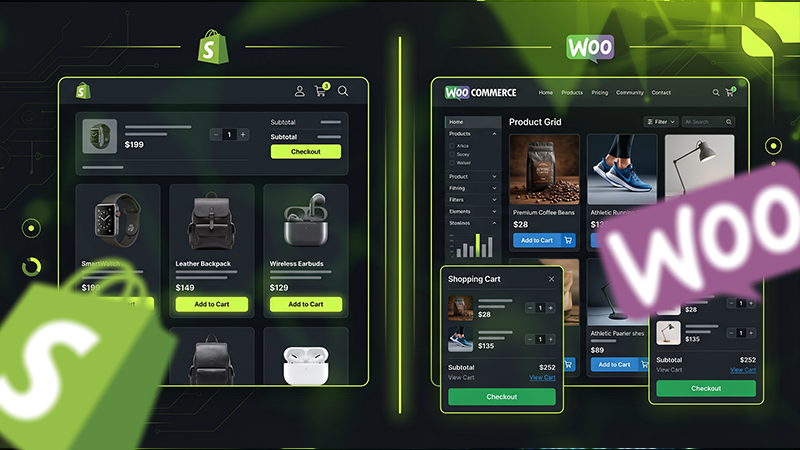
Cost: real total cost of ownership over 24 months
Sticker prices lie. Here’s the actual cost picture over two years for a typical MENA SMB store with 200 SKUs and modest traffic.
Shopify (Basic plan)
- Platform: $39/month × 24 = $936
- Theme (premium): $300 one-time
- Apps (typical 5–8 needed): $30–80/month average = $720–1,920
- Transaction fees (if not using Shopify Payments): 2% per sale
- Domain: $15/year × 2 = $30
Approximate 24-month platform cost: $1,986 – $3,186 before transaction fees.
WooCommerce
- WordPress: free
- Hosting (managed WP, e.g., SiteGround GrowBig or higher): $30–50/month × 24 = $720–1,200
- Theme (premium): $50–80 one-time
- Plugins (WooCommerce extensions, security, performance, backup): $200–600/year × 2 = $400–1,200
- Developer time for maintenance (essential): 2–4 hours/month average at agency rate
- Domain + SSL: $20/year × 2 = $40
Approximate 24-month platform cost: $1,200 – $2,500 + maintenance hours.
The crucial line is the last one. WooCommerce looks cheaper until you cost the maintenance. Once you factor in 2–4 hours of agency or freelance time per month, the gap closes, and for some clients, WooCommerce actually ends up more expensive over 24 months.
Arabic, RTL, and bilingual stores: which platform handles MENA better?
This is where the comparison gets MENA-specific and where most generic global articles get it wrong.
Shopify handles Arabic and RTL through its Markets feature plus theme-level RTL support. The newer themes (Dawn, Sense, Origin) all support RTL natively. Translation is handled through apps like Weglot or LangShop, or Shopify’s own Translate & Adapt. It works well for typical SMB stores; it gets clunky for stores with deep content needs (long blog posts, complex product descriptions with embedded formatting).
WooCommerce wins on Arabic flexibility because WordPress itself is Arabic-native at the CMS level. Plugins like WPML or Polylang handle multilingual content elegantly, and you have full control over every RTL styling decision. For a brand serious about Arabic-first content, WooCommerce gives you more freedom.
Practical recommendation: if 80%+ of your traffic will be in one language, either platform is fine. If you’re building a truly bilingual brand where Arabic content is at least as important as English, WooCommerce + WPML is the sharper tool.
Payment gateways that matter in the GCC
For MENA stores, this is where many platform comparisons fall apart. Generic “PayPal works on both” articles don’t help when you actually need Mada, Tap, Tabby, and Tamara.
Shopify supports natively or via app:
- Mada, yes (via Checkout.com, Tap, or PayTabs apps)
- Tap Payments, yes (official Shopify Plus app, also works on Basic)
- MyFatoorah, yes (official app)
- PayTabs, yes (official app)
- Tabby (BNPL), yes (official app)
- Tamara (BNPL), yes (official app)
- STC Pay, yes via Tap or Checkout.com
WooCommerce supports: All of the above through plugins. The plugins are often community-maintained rather than officially supported, which is usually fine, occasionally breaks.
The net: both platforms support what you need. Shopify’s integrations tend to “just work” out of the box; WooCommerce’s may need 1–2 hours of configuration to get right. Either way, this isn’t a deal-breaker.
SEO and content depth: where each platform wins
Shopify SEO in 2026 has improved meaningfully over the past two years. URL structures are clean, schema markup is mostly automatic, the new themes are fast. The lingering weakness: URL structures still include /products/, /collections/, and /pages/ prefixes, which you can’t remove. For most brands this doesn’t matter. For brands competing on aggressive keyword-rich URLs, it’s a small handicap.
WooCommerce SEO is essentially WordPress SEO, which is the most documented and plugin-supported SEO ecosystem in the world. Yoast, RankMath, Schema Pro, all the tools are richer. You can structure URLs however you want. The catch: with great flexibility comes great responsibility. WordPress sites that are poorly optimised perform worse than badly-maintained Shopify stores.
If your business depends heavily on content marketing (blog posts driving 30%+ of traffic), WooCommerce gives you a slight edge. If your business is primarily product-led with paid acquisition, Shopify is more than enough. We dug into the broader cost question in our website cost guide for Dubai — worth a read if you’re still scoping budget.
Scaling beyond 100 orders/day: where the platforms break
Most MENA SMBs never hit this scale, but if you do, the platforms diverge.
Shopify scales gracefully up to several thousand orders per day on Basic and Shopify plans, with the architecture upgrade path being to Shopify Plus ($2,300+/month). The transition is smooth. Major brands across the GCC run on Shopify Plus.
WooCommerce scales as well as your hosting allows. At 100+ orders/day, you’ll need to upgrade hosting to a dedicated VPS or managed enterprise WordPress host (Kinsta, WP Engine, Pressable). At that point, your monthly hosting bill alone will exceed Shopify Basic’s cost. The architecture limit is essentially the limit of how much database optimisation and caching you’re willing to invest in.
Practical guidance: if you genuinely expect to do 100+ orders/day within 12 months, build on Shopify. The scaling story is more predictable.
When to choose Shopify, when to choose WooCommerce
We treat the decision as a three-way fork:
Choose Shopify if:
- You want to launch in 4–6 weeks with minimal maintenance overhead
- You don’t have a dedicated tech team and won’t add one soon
- Your store is primarily product-led, with content as a secondary channel
- You expect to scale, and you want a predictable cost curve
Choose WooCommerce if:
- You’re building a content-first commerce brand where the blog drives 30%+ of revenue
- You want deep Arabic-language flexibility
- You have an in-house developer or agency partner you trust on maintenance
- You already have an active WordPress site and don’t want to split your stack
Choose neither (custom build) if:
- Your business has unusual UX requirements (multi-vendor marketplaces with complex commission logic, deeply custom subscription flows, B2B portals with complex pricing)
- You’re an enterprise with a tech team and a 2-year roadmap
How we choose at AVMDEVS
Our default is Shopify. Roughly 70% of the e-commerce projects we ship for MENA clients are built on it, including our Snapshot Smart Home build (which sold through $7,000 of inventory in its first run and grew into a brand with a physical storefront in Jbeil). Shopify gets new clients to revenue fastest, and “first revenue” is the milestone that decides whether the business survives long enough to need anything fancier.
We pick WooCommerce when the brand is content-first or aggressively bilingual. We pick a custom build when neither platform can express the business logic — rare, but it happens.
If you’re picking between them right now, send us a short brief at info@avmdevs.com : what you’re selling, how many SKUs, which countries you’re shipping to, what languages you need. We’ll tell you which platform we’d recommend, and we’ll tell you why, even if our answer points you toward a competitor.
Frequently asked questions
Can I switch from WooCommerce to Shopify later (or vice versa)? Yes, but it’s painful. Migrating products, customer accounts, order history, SEO redirects, and integrated apps typically costs $1,500–$5,000 for a small store, more for a large one. Start with the right platform.
Is Shopify worth it given the transaction fees? If you use Shopify Payments (available in UAE and KSA), there are no transaction fees. If you use a different gateway, you pay 2% on Basic, 1% on Shopify, 0.5% on Advanced. For most SMBs the difference is meaningful — usually worth using Shopify Payments where available.
Which platform handles VAT (UAE and KSA) better? Both. Shopify has cleaner native VAT setup in the Markets/Tax settings. WooCommerce needs a tax plugin or manual configuration. For KSA-specific ZATCA e-invoicing, both require a separate integration. We covered KSA setup in detail in our Shopify localization guide for Saudi Arabia.
What about Adobe Commerce (Magento)? For SMBs, Magento is almost always overkill. It’s an enterprise platform with enterprise overhead. Skip unless you have a tech team of 5+ and complex multi-store, multi-language, multi-currency requirements.
What about Wix or Squarespace? Fine for single-page brochure sites with a small online shop. Don’t build a serious e-commerce business on either, both are limited on payment integrations, scale, and SEO depth compared to Shopify or WooCommerce.
Want help picking?
We build on both. Tell us about your product catalogue, target markets, and growth roadmap at info@avmdevs.com, and we’ll recommend the right stack, without selling you a platform we don’t believe in. See our e-commerce package pricing for typical build costs.