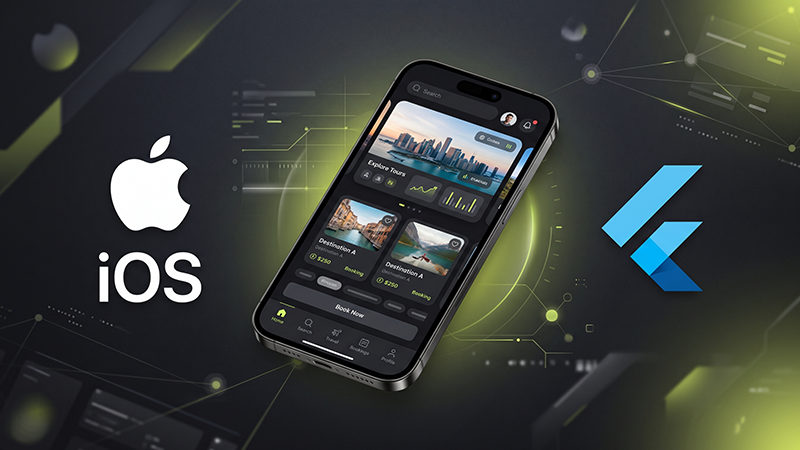
We build on both. We’ve shipped native iOS apps in Swift, native Android in Kotlin, and cross-platform builds in Flutter. The question of which framework to choose is one of the most expensive decisions a startup makes in its first year, wrong call here costs you six to twelve months of rebuild work. Here’s how we’d help you decide, with the honest tradeoffs.
The 3-second decision: which are you, A or B?
You’re A if: you’re a MENA startup trying to validate a product idea, your budget is finite, you want to ship to both iOS and Android, your app is primarily about UI/workflows/forms/standard interactions, and you need to be in market within 4–6 months. Pick Flutter.
You’re B if: your product depends on platform-specific APIs (deep iOS-only features like advanced HealthKit, ARKit beyond basics, Vision Pro integration), or your product is graphics-heavy (3D, games, complex animations at 120fps), or you’re a well-funded later-stage startup that can support two separate native teams. Pick native iOS (and a separate native Android build).
If neither description fits cleanly, you’re A. Default to Flutter unless something specifically forces native. Here’s why.
What native iOS gives you in 2026 (and what it costs)
Native iOS in 2026 means Swift, SwiftUI, and the full Apple developer toolchain. The advantages:
Performance ceiling. Native is faster than cross-platform, full stop. For 95% of apps the difference is imperceptible. For graphics-intensive apps, complex animations, ARKit experiences, or anything that pushes the GPU, the difference is meaningful.
Deepest platform integration. SwiftUI gives you native-feeling UI. Apple’s APIs (HealthKit, HomeKit, CarPlay, Vision Pro / visionOS, advanced ARKit, App Clips) require native development. If your product needs any of these, native isn’t a preference, it’s a requirement.
Best Apple developer experience. Xcode is mature, debugging is excellent, App Store submission is straightforward when you’re staying inside Apple’s preferred patterns.
The costs:
You ship to one platform. Native iOS is iPhone (and iPad and Mac and Vision Pro) only. To reach Android users, roughly 60–70% of MENA mobile users, you need a separate native Android build, which means a separate team, a separate codebase, and roughly double the build cost.
Higher engineering hourly rates in MENA. Senior Swift developers in Beirut, Cairo, and Riyadh command 20–40% more than equivalent Flutter developers. The talent pool is smaller and tighter.
Slower MVP iteration. Two codebases means two implementations of every feature, two QA passes, two release cycles. For a startup iterating weekly, this compounds painfully.
What Flutter gives you in 2026 (and what it costs)
Flutter has matured dramatically since 2022. In 2026 it’s the default cross-platform choice for most production work. The advantages:
One codebase, two platforms. Build once, ship to iOS and Android (and increasingly to web and desktop, though those are secondary use cases). For a startup with a finite budget, this is typically a 30–40% cost reduction on MVP delivery and a 50%+ reduction on ongoing maintenance.
UI consistency. Your iOS and Android users get the same experience. If your brand is heavily UX-driven, this matters. Native apps tend to drift apart visually because designers have to make Android-vs-iOS decisions for every component.
Faster iteration. One bug fix, one feature, one deploy. Hot reload during development is excellent. Release cycles compress.
Growing MENA talent pool. Flutter developers have become significantly more available across Beirut, Cairo, Amman, Riyadh, and Dubai. Hiring is easier and cheaper than for senior Swift.
The costs:
Platform-specific edge cases. You’ll occasionally need to write native iOS or Android code to bridge a feature Flutter doesn’t support natively. This is rarer in 2026 than it was three years ago, but it does happen, usually for deep system integrations.
Apple Vision Pro and visionOS. No Flutter support yet. If you’re building for spatial computing, you’re going native.
Performance ceiling. As mentioned, Flutter is fast enough for 95% of apps. For high-performance graphics, games, or complex 3D, you’re going native.
App size. Flutter apps are typically 10–20MB larger than equivalent native builds. For consumer apps this rarely matters. For markets with bandwidth constraints, it occasionally does.
Cost comparison: 6-month MVP build, native vs Flutter
For a typical MENA startup MVP, say, a service marketplace or B2C consumer app with social login, payment integration, and 8–12 core screens, these are the realistic build cost ranges in 2026.
| Build option | Beirut/MENA agency rate | Months | Approximate cost |
|---|---|---|---|
| Flutter (iOS + Android, single team) | Senior Flutter dev + designer + PM | 4–6 | $25,000 – $50,000 |
| Native iOS only | Senior Swift dev + designer + PM | 4–6 | $20,000 – $40,000 |
| Native iOS + native Android (two teams) | 2 senior devs + designer + PM | 5–7 | $45,000 – $90,000 |
| React Native (cross-platform) | Senior RN dev + designer + PM | 4–6 | $25,000 – $50,000 |
The “native iOS only” row is technically cheaper than Flutter for the MVP. But you’re also reaching only ~30% of your potential MENA user base. For most consumer apps, that’s a death sentence.
The honest answer for budget-constrained startups: Flutter is the cheapest path to reaching both iOS and Android users with a polished product.
Performance and UX: where the gap closed, where it didn’t
Three years ago, Flutter apps frequently had recognisable “Flutter feel”, slightly different scroll physics, slightly off-pattern animations, slightly delayed touch responses. By 2026, most of this has been engineered away. A well-built Flutter app is indistinguishable from native to 99% of users.
Where the gap remains:
Complex scroll-driven animations. Native still wins for sophisticated parallax, scroll-reactive headers, and complex transitions. Flutter does these well, but native does them slightly better.
System integration UX. Native apps respond to system events (notifications, background tasks, file pickers) with marginally smoother UX. The difference is small.
Vision Pro and AR-heavy experiences. Native only, for now.
Games. Don’t build a game in Flutter. Use Unity, Unreal, or native.
For literally anything else, the choice should be made on team and cost, not on performance.
Hiring: who can you actually find in the MENA market?
This is the question most strategic decks skip and most startups regret.
Flutter developers are now widely available across Beirut, Cairo, Amman, Tunis, and increasingly Riyadh and Dubai. Mid-level salaries run $1,500–$3,500/month in Beirut and Cairo, $3,000–$6,000/month in Dubai and Riyadh. The community is active, the pipeline of new developers is healthy.
Native iOS (Swift) developers exist but the pool is smaller. Mid-level: $2,000–$4,500/month in Beirut/Cairo, $4,500–$8,000/month in Dubai/Riyadh. Senior Swift developers in MENA are particularly hard to find, they tend to get hired by major regional fintechs and stay.
Native Android (Kotlin) has a similar story to iOS, though the pool is larger.
React Native is the third option many startups consider. Pool is large globally but shrinking in MENA specifically as Flutter takes share.
For a startup that needs to hire its first mobile engineer within 90 days: Flutter is the most predictable hire. Native iOS is doable but takes longer.
When to pick native iOS, when to pick Flutter, when to pick React Native
The cleanest decision tree:
Pick native iOS if:
- Your app requires iOS-only deep platform features (Vision Pro, advanced HealthKit, complex ARKit)
- Your product is graphics-heavy or animation-heavy enough that the performance ceiling matters
- You’re a later-stage startup with budget for parallel native iOS and Android teams
- Your audience skews 80%+ iPhone (uncommon in MENA outside specific premium niches)
Pick Flutter if:
- You’re shipping to both iOS and Android
- Your team is small (single mobile engineer or 2-person mobile team)
- Your product is UI/workflow-heavy rather than graphics-heavy
- You need to iterate weekly and ship features fast
Pick React Native if:
- You already have a JavaScript/TypeScript team and don’t want to re-skill on Dart
- You’re integrating tightly with a React web codebase and want code sharing
- You’ve used it successfully before and the team is comfortable
The honest answer in MENA in 2026: Flutter is the right call for roughly 70% of startup mobile projects. Native iOS-only is right for about 15% (premium iPhone-skewing apps, deep iOS feature integration). Two native teams is right for about 10% (later-stage, funded). React Native is right for about 5% (existing JS shops).
How we choose at AVMDEVS (and why it’s usually Flutter)
Our default recommendation for MENA startup MVPs is Flutter. We’ve used it for Payverly and several other client builds where shipping to both iOS and Android quickly was the priority.
We recommend native iOS when the client has a clear iOS-deep-feature requirement or when the product roadmap explicitly excludes Android for the first 18 months.
We recommend native Android (Kotlin) as the parallel build only when budgets support two teams from day one.
We push back on clients who want native because “native is better.” For an MVP-stage product, faster iteration and broader platform reach almost always beat marginal performance gains. If you’re not pushing the GPU and you’re not deep in iOS-only APIs, Flutter is the better business decision.
Want help deciding?
Tell us about your app idea, what you’re building, your timeline, and the platforms you need to ship on. Reach us at info@avmdevs.com. We’ll recommend the right framework, even if it’s the one we don’t specialize in. See our mobile app development service for typical build packages and pricing.
Frequently asked questions
Is Flutter ready for production in 2026? Yes, comfortably. Major brands worldwide, including BMW, Toyota, Alibaba, Google Pay, run consumer apps on Flutter. The “is Flutter production-ready” question was answered in 2023; it’s no longer interesting.
Should I worry about Flutter being abandoned by Google? Low risk. Google uses Flutter for several flagship products (Google Pay, Google Earth, parts of Google Ads). The community is large and active. Even if Google reduced investment, the open-source community would maintain it.
Can Flutter access all iOS features? Most of them, through plugins. The exceptions are bleeding-edge or highly specialised APIs (advanced ARKit, Vision Pro, some HealthKit flows). For these you’d write a native bridge, a small amount of native code that Flutter calls into.
How long does an MVP typically take in Flutter vs native? Typical MVP timeline: Flutter 4–6 months, native iOS-only 4–6 months, native iOS + native Android (parallel) 5–7 months. The “savings” from Flutter come from reaching both platforms with one codebase.
What about React Native vs Flutter? Both are mature cross-platform options. Flutter has gained more momentum in MENA and globally over the past three years. React Native is still excellent, especially if you have an existing JavaScript team. We use Flutter as our default but build in React Native when client context calls for it.