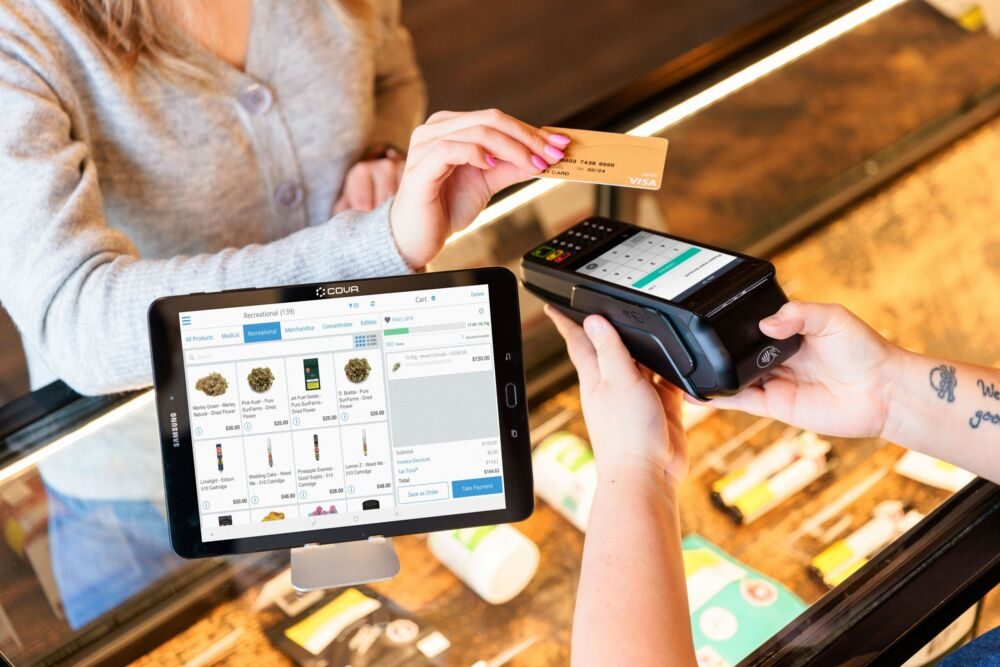
A few years ago choosing a point of sale system in Saudi Arabia was about the same things as anywhere else: how fast the checkout was, whether it handled inventory, what the hardware cost, whether the reports were any good. That list still applies, but a new item now sits above all of it. The system has to produce compliant electronic invoices and, for most businesses, integrate directly with the Zakat, Tax and Customs Authority's Fatoora platform. A POS that cannot do this is not a bargain at any price.
The scope keeps widening. Wave 25 of the integration phase, announced on 24 July 2026, brings in every business whose VAT-subject revenue exceeded SAR 187,500 in any of 2022, 2023, 2024 or 2025, with integration due by 1 February 2027. That threshold is half of what it was one wave earlier, and it reaches into cafes, salons, small retailers and single-location restaurants that assumed e-invoicing was a large-company concern.
What compliance actually requires at the counter
For a retail or hospitality business, most invoices are simplified tax invoices, issued to consumers. Under the integration phase these must carry a cryptographic stamp, a UUID, a hash chain linking each invoice to the previous one, and a QR code with a defined set of fields, and they must be reported to Fatoora within a defined window after issue. Standard tax invoices, issued to VAT-registered businesses, go through clearance, meaning the authority validates them before they are legally issued.
The practical consequences for a POS are significant. It needs an onboarding process to obtain and renew its cryptographic stamp identifier. It needs to keep issuing when the connection drops and report afterwards, without breaking the chain. It needs to handle returns and credit notes as compliant documents rather than as a negative sale. And it needs to do all of this on every device in every branch, consistently, because a single non-compliant terminal is a non-compliant business.
The three kinds of POS on the Saudi market
The first is the international cloud POS that has added Saudi compliance as a module. These tend to have polished interfaces and good reporting, and their ZATCA support ranges from excellent to nominal. The question to ask is whether Phase 2 integration is native, certified and included, or whether it depends on a third-party connector with its own subscription and its own failure modes.
The second is the local Saudi POS built for this market from the start. Arabic-first, compliance-first, often with Mada and the local wallets integrated out of the box, and with support that understands what a ZATCA rejection message means. The interfaces vary in quality and the reporting can be thinner, but the compliance story is usually the most straightforward.
The third is the ERP-connected POS, where the till is a front end to a system like Odoo and the accounting, inventory and e-invoicing all live in one place. This is the right answer for a multi-branch business with real inventory complexity, and the wrong answer for a single cafe that needs to open next month.
What to check before you sign
Ask the vendor to show you a simplified invoice being issued and reported on a live device, and to show you what happens when the internet is unplugged mid-shift. Ask how the cryptographic stamp is renewed and who is responsible when it expires. Ask what a ZATCA rejection looks like to a cashier and what the recovery process is.
Then ask the ordinary questions with Saudi specifics. Does it take Mada natively and at what cost per transaction. Does it integrate with the delivery platforms your business depends on. Does it produce reports in Arabic for the accountant and in English for the owner, if that is your situation. Does it handle the split between dine-in, takeaway and delivery pricing where VAT treatment or service charges differ. Can it print in Arabic properly, with correct shaping, on the receipt printer you already own.
Finally, ask what happens to your data if you leave. Sales history, customer lists and inventory records belong to the business, and a POS that makes them hard to export is holding them hostage.
Integration is where the value is
A POS on its own is a till. A POS connected to your inventory, your accounting, your ecommerce store and your delivery partners is an operating system for the business. Sales in a branch reduce stock that the online store is also selling. A price change made once reaches every channel. The accountant sees the day's takings without anyone typing them in. This is the difference between a business that knows its numbers and one that reconciles them at month end.
It is also the part vendors rarely include. The connector between the POS and the accounting package, between the POS and Salla or Zid, between the POS and the delivery aggregator: each is a small integration project with its own data quality problems, and each is where compliance quietly breaks when a return handled in one system never reaches the other.
This is the work AVMDEVS does most often around point of sale in the Kingdom: not selling the terminal, but building the connections that make it part of a system, and making sure that every route an invoice can take ends in Fatoora. Our POS and retail systems service describes it and the brief form is where to tell us what you are running.
For the compliance detail, ZATCA Wave 25 and what the integration phase requires goes further. If online sales are part of the picture, the Salla, Zid and Shopify comparison covers the platforms most Saudi POS systems need to talk to, and POS systems for UAE retailers is the companion for a business trading on both sides of the border.